Showing posts with label Classroom Management. Show all posts

Thursday, September 10, 2015

Using ClassDojo Effectively


Technology Thursday is a weekly linky dedicated to all things technology related. Check out our Tech Thursday page for details on how to link up!


I happen to love ClassDojo! I adore my classroom’s Dojo Mojo, so to speak. I use the website for attendance, picking students for tasks, motivation, management, timing activities, and parent communication. But the uses of ClassDojo are not my focus in this blog. See the links below if you have questions about what ClassDojo is and what the site can do for you.

I have been a ClassDojo mentor for a couple of years now and have seen many teachers jump on the Dojo bandwagon. Most of the time, the teachers implement Dojo seamlessly into classroom routines.  But every once in a while, I see a teacher (or read about a teacher) not using Dojo as effectively as it should be used. Let me explain.  ClassDojo is a classroom management tool.  So for our purposes, let’s compare it to another tool- the hammer.  I could use the hammer handle to attach a nail to a board and it would work…eventually- it is just not as effective as using the head of the hammer. You get the job done but, boy, did you struggle along the way.

Here are my 6 tips for using ClassDojo effectively.

Set Expectations


For Students: Students need to know what behaviors you are targeting. Go through your list of Positive behaviors and Needs Work behaviors in a class meeting. Ask the students what they think each behavior would look like. Get their input on which behaviors need to be added and which should be worth more than 1 point.  This helps give them a “buy in” for the program. It’s their class. It’s their Dojo. But yes, this needs to be a guided process- teachers have a say too.

For Parents: Parents need to know how you are going to use this tool. They need to know how the communication is going to work, and, more importantly, what it means when their students lose a point. I always inform parents (and students) that everyone loses a point here and there; no one is perfect 100 percent of the time. You need to let parents know that if a real behavior issue arises; you will get in contact with them (besides just seeing points disappear).


Be Positive


When I became a teacher, our professors taught us to change the things we said from the negative, “Stop running!” to the positive, “Walk please!”   They also taught us newbie teachers that praising a child that is doing the right thing can be more effective than disciplining the student that is doing the wrong thing. I take this approach with ClassDojo. I have almost double the amount of Positive behaviors as I do Needs Work behaviors. I also give out quadruple the number of positive points than I do taking points away.  It is so much more rewarding for your classroom atmosphere to be positive rather than negative.

Here’s what happens if you only take points away or are overall negative- the students stop caring about Dojo. They can’t win or get ahead, so why try? Who can blame them?  I don’t like things I am unsuccessful at either.

I know what you are thinking…what about (insert name here)? They never are on task! Yes, they are. You just have to look a lot harder to find the Positive behaviors.

Try this: Joe is off task again and is playing in his desk.  I give 3 other students points for doing their work. Joe then starts doing his work.  I give Joe a point for “joining his friends”.

Or this: Catch Joe early in the morning. Joe hung his backpack up. Point. Joe put his folder in the correct place. Point. Joe put his name on his paper. Point.  Great answer to that question, Joe. Point.
Now Joe sees that he can get points; he can succeed. He likes Dojo points. So if I eventually have to take a point away, it is more effective.

Now Joe’s parents like ClassDojo. For the first time in little Joe’s life, they are getting some positive feedback about their child!

Give Points Often


Don’t be stingy! Give out points! Reward those good behaviors! Always be on the lookout for a behavior to give a point to.  I always tell my students that I LOVE giving out points. I also tell them, “I’m in a Dojo givin’ mood today!” I sometimes even relate to the students what behavior I am on the lookout for.

Try to give points to everyone. Spread the wealth! Look at your reports. Are there students you are overlooking?  Is there a particular student that is running away with all the points? Is there a student that you are only taking points away from? Has it been a long time since you rewarded a particular student?

Tip: I never let the kids ask for a point. Dojo begging is not allowed. They can, however, suggest a friend gets a point, but they have to explain to me why.


Let the Students Take Charge


I take the time to actually teach the students how to run ClassDojo. I show the kids how to use the attendance, random picker, the timer, giving (or taking) points, and resetting points. Believe me, this will make your life so much easier. The kiddos love, love, love to give themselves points. They actually love to do anything on the website.

Tip: I leave the website open all day on the computer. You can minimize the window if needed.


Start Each Day Fresh


If some students have dug themselves into a hole of negative Dojo points that never seem to go away, they will stop caring. Dojo becomes irrelevant for these children. They feel that they can’t crawl out of the hole, so why try? We want to avoid this. Reset the negative points at the end of the day. Tell the students that each day is new and you get a fresh start. Don’t leave them hangin’ out in Negative Land. Let them start with a clean slate each day!


Set a Limit to Points


I set a limit to the amount of points students can receive and let them go to the treasure box when they reach that goal. I, then, reset their points to 0, and they start the cycle all over again. Why? Well, if Sally has 230 points and I only have 56, I will never catch up. 

I asked my students about this one. I asked them how they would feel if someone had a lot more points than them. Here are some things they said:

  • I would be disappointed because I wouldn’t have points.
  • If everybody else has more points, they might make fun of me.
  • I’m trying to get there, but he’s always ahead of me.
  • I would be sad because I am working hard and not getting points.
  • They also said they would be happy for their friend with lots of points. AWWWWHHHH!


I usually start out with an easy goal of 10 points. I am trying to get everyone to LOVE ClassDojo. I want them to love going to the treasure box. I need my students to WANT points. I do this for about a week, which is just enough time for everyone to experience the success of going to the treasure box. Then I raise the goal to 15 points, and then, ultimately, to 20 points for my 3rd graders.  

A good thing happens with this system of resetting points. My Joe (from above) will have more points than the best behaved kids in the class on some days because those well-behaved kiddos just reset their points back to 0. They have 0 and he has 8. Rock on, Joe! On any given day, the gap for student points can be 0-20- which is an entirely attainable goal. There is not a signaling out of kids this way, and all students appear to be just as successful as the others.

Tip: You can still see how many points each student has for the week, month, or year in your reports.

Tip: I use certificates for treasure: chew gum in class, sit in the teacher’s chair, bring a furry friend, 
wear a hat…etc.

Tip: Use only your students' first names, initials, or class numbers to keep anonymity.


There you have it…my tips for being a successful Dojoer.  You are now ready to get started Dojoing! Let us know if you have any questions!


If you need more information about ClassDojo, check out our other Dojo blog posts.


Link up below with your own Website or App recommendations, Tech Tips, Tutorials, or anything else tech-related! We can't wait to learn from you!

 photo Signature-JULIET_zpskkoxehux.png


Thursday, August 13, 2015

What’s New on ClassDojo? {Tech Thursday}


Technology Thursday is a weekly linky dedicated to all things technology related. Check out our Tech Thursday page for details on how to link up!

ClassDojo is one of my all-time favorite classroom websites. I use it more than any other. Today, I ‘m not going to go into a lot of detail about the site, because we’ve already blogged about it here.
Today, I’m super excited to share with you the two newest ClassDojo features…

Yes, that says GROUPS! Now you can easily create groups within your class to award table points, boys vs. girls points, etc. This is probably one of the most-wished-for features in my teacher circle, and it’s finally here! I love that I can put the same student into more than one group, so I can really be flexible with how I use them and when I give points.

 Class Story is a really cool feature that will make it easy to keep parents connected and share what’s going on in the classroom. It will look and feel a lot like your “wall” on a certain social media network, but with some very important differences just for the classroom setting: 1) Parents and students can “like” your posts by clicking the heart, but they cannot comment on them. 2) Everything is private and secure. (ClassDojo is FERPA & COPPA compliant.)

I plan to use Class Story for photos from class, homework, sending links to parents, reminders about events and projects, and shout-outs for student of the month and birthdays.

If you ever need help with anything Dojo, don’t hesitate to reach out to us… there are a couple of ClassDojo mentors here who are happy to help!

Link up below with your own Website or App recommendations, Tech Tips, Tutorials, or anything else tech-related! We can't wait to learn from you!


Thursday, July 23, 2015

Growing a Healthy Classroom Mindset


You know how you browse the internet while mindlessly watching something on T.V. Well one day I happened upon a video. That video really caught my interest. I just couldn't shake some of the things the lady said. That video led me on an extensive internet search. I just had to find out more. That video then led me to a book. And eventually led me to a change in my thinking about my students, my teaching, and myself.

The woman speaking was Carol S. Dweck, Ph.D. And the title of the video was "The Power of Yet". She was teaching on mindsets - the fixed mindset versus the growth mindset. And what she was saying shook me to the roots of my being. No joke. It was like a classic AHAAAAA! moment. To summarize: fixed mindsets lead to failure and growth mindsets lead to success. Even briefer (use your best caveman voice)- fixed mindset "bad" and growth mindset "good". When I reflected upon myself, I realized I had a mixture of both mindsets. In some areas of my life, the growth mindset is absolutely embedded in my way of thinking. But in other areas, the fixed mindset ruled.

Here is a graph to help give you the basics of each mindset.


I couldn't help but connect what I was learning about mindsets with my Christian beliefs. It actually fits right in with God's way of thinking. The word is filled with people that were chosen to become more than what was expected of them. Examples are David, Gideon, Joseph, Esther, Ruth, Peter, and Paul. God helped each of them rise above their circumstances of birth. One of my favorite verses is Philippians 4:13, "I can do all things through Christ who strengthens me."  My question is, "Why have I not been applying this to every area of my life?"

I also started thinking about my students and their mindsets. I see so many students that fall into that fixed mindset category. They give up so easily. They don't try new things. They back away from challenges. How can I help them?

I came up with a plan- start the year off training my students in the growth mindset. I plan to teach my class about each mindset and why we need to have the growth mindset. I also want to instruct them in what I feel are the "tenets" of a growth mindset.

Of course I created a product to help!


Growing a Healthy Classroom Mindset is designed to cover at least 20 days of instruction. Teachers introduce the basic knowledge concerning mindsets and brain research. They then present a growth mindset statement each day. Discuss the statement and what it means. As each statement is covered, add the accompanying poster to a bulletin board to create an inspiring display that can be referred to throughout the year. Introduce concepts with a PowerPoint, posters, and student handouts.

Growing a Healthy Classroom Mindset!


 Here is Dweck's video that started my journey.


If you would like to know more, here are a couple of links to articles about Dweck's research and book, Mindset: The New Psychology of Success.

Educational Leadership: The Perils and promises of Praise
Scientific American: The Secret to Raising Smart Kids

What mindset are you?


Friday, March 6, 2015

5 Reasons Teachers Might Come to Work Sick


All teachers have to take off days.  All teachers have appointments, have sick kids, or get sick themselves.  I know it's hard to believe, but it happens.  There are really exceptional substitutes in each school district BUT.... most teachers still don't like having to take a day off.  Why?  Most times, it is more trouble than it is worth.  I have heard so many teachers say that they would just rather come to school sick rather than having a sub. I am one of them.

I recently had to take 4 days off of work for sickness ...in a row.  I bet if you are a teacher you just groaned.  I had no choice.  I couldn't expose my kids to my virus, and doctor's orders are doctor's orders.  But oh how I hated it.  No matter the quality of my substitutes, I knew my classroom, plans, and students would be in disarray.  I also knew I would be spending tons of time trying to catch up for time off.

Preparing for a Sub


Preparing for a substitute take lots of pre-planning. You have to ready student rosters, individual schedules, classroom schedules, medical conditions (if needed), discipline plans, lesson plans, copied papers... and the list goes on.  All of this has to be in a place and written so that the substitute can locate them, decipher them, and then implement them.  Big signs that say, "Sub Look Here" or Sub tubs, or sub folders are placed in strategic locations around teacher desks.  This takes loads of time and effort.  I try to have this prepared early in the year.  Ideally, my substitute plans would be in place before the first day.  I know... you teachers just laughed because that never seems to happen.  But even once you get it all ready, you still have to update items as the year progresses.

More time and more effort all for the event that you might need a sick day.

Lesson Plans


Writing lesson plans for a substitute is tricky.  The lesson plans we write for ourselves are not always what a sub needs or wants.  Substitutes need more details and more instructions.  Some subs only want worksheets.  Our lesson plans may have cryptic words that tell us, the teacher, exactly what to do, but a substitute would have no clue.  It usually takes me at least 1 planning period to rewrite my lesson plans for a substitute- to make them more detailed and understandable. This is when I know I am going to have a substitute.  When you are a loved one is sick, you have to already have something in place or be able to adapt your lessons from home.  One reason why I use Planbook.com is that I can move lessons around easily and email the plans to a fellow teacher from home.

Okay, I will admit that when I became sick last month and knew I would be out for over a day, I implemented drastic measures.  I had my 15 year old daughter (who has a driving permit) drive me to school at 7:00 pm while I had 102 fever.  We spent over an hour at my school, in the dark, all alone, trying to prepare for a couple of sick days.  Thank God my daughter helped!

If you are not a teacher, you are probably shocked.  If you are a teacher, you are probably just nodding your head and saying, "Been there. Done that. And have the t-shirt."

There are also certain lessons that I don't want a sub teaching, such as the introduction to multiplication. This is what happened to me this year.  I was scheduled to introduce multiplication and then came down with a serious bug.  I had to postpone the unit until I returned because it was too important for someone else to teach.

Changing lesson plans = time spent.

Reteaching

Which leads me to my next point...although there are fabulous substitutes, there are some that are not so great.  I have had to reteach topics that I thought any adult could teach.  Not the case.  Many substitutes have no formal teaching experience. They may not know how to introduce a topic, check for learning, and differentiate lessons.  If you are lucky, you can get a retired teacher.  These are the best!

I also want to mention that there is no guarantee that if you are out for a couple of days that you will have the same substitute each day.  I didn't.  I had 2 different subs, but you could have a different substitute each day.  This is not best practice for the students since each substitute is teaching in a different style and setting different expectations.  Reteaching then becomes imperative.

More time.

                        Students are a Mess

Taking time off can derail students' behaviors in a big way.  It is sometimes like the students have been on vacation- no rules, just play- and that they have conveniently forgotten how to behave. We, as teachers, have to come back into the classroom and settle them down, reinstate the rules, and remind students that we are still about the business of learning.

If you have a troubled student or a special needs students, a substitute may not know how to work with these students.  The teacher being out of the classroom can really be the catalyst for extreme behaviors. While I was out for 4 days, I received an email from a mom, who then contacted our school liaison and my school principle.  I then had several phone calls while I was sick from my principal about this student.  Top priority when I returned to school was to meet with the parent. All of this was for behavior when I wasn't even in the classroom.

Sigh. More time.


Classroom is a Mess

Teachers work hard on their classrooms.  They arrange, decorate, rearrange, redesign, and then do it all over again. We spend time teaching and training students on how to "live" in our classroom. Students know the rules of the classroom, pencil rules, where papers go, and how to clean up.  I love working in my classroom.  It is like my little sanctuary.  I have my favorite colors and things arranged just like I like them.  Imagine having someone else living in your sanctuary for a couple of days.  With 20 kids.  Who are conveniently forgetting all of the rules they are supposed to know. That's what having a substitute in your classroom is like. No matter how good of a substitute they are, they are not you.  I have actually taken a huge breath with my hand on the classroom door, steeling myself for what is inside.  Sometimes it is okay.  Oh, but other times, I would swear a tornado went through my room.

Even more time.


Time.  Something that you can't buy, but you can spend so easily.  Time.  Something that you lose quickly, but never get back.

I figure for every 1 day a teacher takes off, 2 days are spent in either the pre-planning or the post substitute clean up. So if this holds true, I was out for 4 days and spent 8 days either planning or getting everything straightened back up and on track.  Pause...Thinking....Yeah...that's about right. No wonder teachers come to work sick...

Head over to DoodleBugs to check out everyone else's Five for Friday!


Here is a post we have done on Planbook.com in case you are interested.


Wednesday, January 7, 2015

Favorite Things Linky: Classroom Management Tips


New Year...New Linky!


Coming to Teaching Trio in January on the first Wednesday of each month is another quick and easy linky party! 


These are a Few of My Favorite Things is a monthly linky where you can share your 3 favorites in any category you want. It could be your 3 favorite picture books, 3 favorite ideas for teaching matter, 3 favorite math websites, or anything else you want to share that week.


Of course raindrops on roses and whiskers on kittens are some inspired choices to share as well! Something about this linky makes me hum a happy tune.....

Here's what to do:
1. Just save the image above, add your text to it (we use PowerPoint), and post! 
2. Include the button above and a link to Teaching Trio on your post.
3. Link up here on the first Wednesday morning of the month (or whenever :) )  The linky will be open for a week.
4. You are welcome to share TPT products, BUT you may only include one of your own products each week. We want to see things from other fabulous TPT authors too! (This post is not intended for self-promotion.)
6. Be a good blog reader, and leave some love for the two posts before yours!


Here is my list of my 3 Favorite Classroom Management Tips!


Find out more about Harry Wong and ClassDojo.com in my previous posts:


Can't wait to see what your Favorite Things are!

Just wanted to say Thank You for entering in our big giveaway! Here are the winners. We will be e-mailing you later today. :) Congrats!!


Tuesday, October 14, 2014

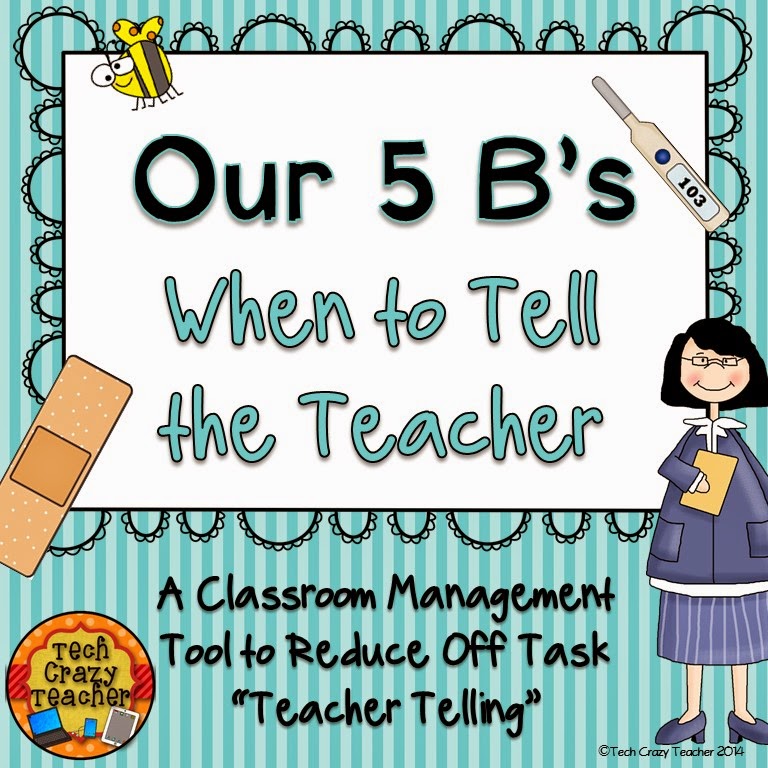
Tried it Tuesday: The 5 B's


Today I'm linking up with Holly at Fourth Grade Flipper for Tried It Tuesday. 


Tired of your students running up and telling you every little thing? Trouble with tattling? Do you have students that need a Band-Aid for a teeny-tiny speck?

Teach your students the 5 B’s!


The 5 B's is a classroom management tool meant to reduce off task "teacher telling" and tattling. The 5 B’s help your students know when it’s appropriate to go to the teacher and what things a teacher needs to know about. What are the 5 B's? The 5 B's are Bleeding, Broke Bones, Being Sick, Bee Sting, and Bullying.


I start this at the beginning of the year, but it can be started at any time. I literally teach my students the 5 B's and what they mean.  I always give them examples such as a teeny speck on their finger that really really hurts but doesn't need a Band-aid or a bee sting is different from spotting a bee.  We review the 5 B's every day for the first week of school (or the first week you introduce it).  

As the year goes on, you can just refer back to the 5 B's.  When my students come up to me at recess, for example, I hold up my 5 fingers and ask if what they are about to say is one of the 5 B's. Most of the time, they just go back and play. Fabulous!


I have used this for a number of years and in a number of grades.  It works!  

Check it out at my TPT store!

Let me know if you have used something similar! 


Friday, August 22, 2014

5 Favorite Harry Wongisms for Classroom Management

It's 5 for Friday Time!  Yay! I am linking up with Doodle Bugs for their popular Friday linky.

I am keeping with the Back to School theme again this week.  I feel like my year is still at the beginning stages, and I am in need of some encouragement.  

Who better to look to at the beginning of the year but Harry Wong and his iconic book "The First Days of School".  


If this is the first time you are hearing about this book, STOP reading my blog!  GO order it RIGHT NOW from the link above!  I bet that is the first (and last) time a blogger will tell you to stop reading her blog...

Seriously teachers, it is the ULTIMATE book on how to start a school year.  It doesn't matter if you are a veteran teacher or fresh out of student teaching- it's a book you need to read.  More than read it- you need to embrace it! You can't go wrong with Harry Wong!  (Sorry...I just had to. ;)


(I hope Mr. and Mrs. Wong will not be insulted by my blog title.  I mean it with all due respect since I try to read their book every year before starting school.)

Okay...first off, I have to try to limit this to just 5 things....ummm....how to do that.......still thinking.......

Right here is where I went back and changed my graphic and added the "classroom management" subtitle.  This is what I need a refresher on in my jungle ummm classroom, so this is going to be my focus.

"The number one problem in the classroom is not discipline; it is the lack of procedures and routines."


This one statement changed my teaching life.  You have to actually TEACH students procedures and routines.  Now why didn't my professors teach me THAT in college?  You have to teach them how to get a sharpened pencil, hang up their backpacks, line up, get out a reading book, go to the library, come to the carpet, use the bathroom, get a drink, and all the other hundred things that happen during the school day.

An effective teacher HAS to have a PLAN for each of these instances AND has to teach the plan to the students.

Here's the thing, students want procedures. They want to KNOW how to go about doing something.  Be careful though and don't confuse procedures with discipline.  Discipline concerns how students behave while procedures involve how students will DO something.

I have to stay here for just a moment and continue with procedures on to number 2.    You have a plan and now you have told the plan to the students.  You have told them how to line up, get a sharpened pencil, go to the library, and so on.  This is NOT enough.  It's not enough to just have a plan.  It's not enough to tell the students how to do something or even to model it for them.


Effective teachers know that all procedures have to be rehearsed!  Mr. Wong states that the first weeks of school are filled with the practicing and rehearsing of all the classroom procedures.  Students cannot be expected to get every procedure right all in one day.  (I needed to be reminded of this one.)  Students need to practice the procedures step by step until it becomes routine and automatic.

The 3 steps to teaching classroom procedures are
1. Explain, model, or demonstrate the procedure.
2. Rehearse and practice the procedure with your class.
3. Reinforce your students with praise and more practice until it becomes routine.

Harry Wong believes that schools must have rules.  These rules provide students with a safe environment to learn without fear.  Classroom teachers need to have rules posted before students come to class.  He feels that there should be no more than 3-5 rules.  He also feels that changes can be made if a situation arises that calls for it.  Consequences can be positive or negative but should be plainly stated.

Mr. Wong's Cardinal Principle of Consequences: Do NOT stop teaching to give out a consequence!

Wow, it that hard to do or what?  Sometimes it is almost impossible.  I have found that this is really a challenge for me.  I am going to have rethink a few things.  What about you?

I must say the most fun Wongism is this one: greet your students at the door.  This is not a huge chapter in his book but almost a small aside.  He mentions it and there is a great picture of him smiling at the classroom door and holding out his hand in greeting.  He does say this, "What you do the instant the student enters the...classroom communicates immediately if the student is welcome there."  I love this.  I believe it sets the tone for the day.


I actually delay opening my door a few minutes so that I can have most of my students outside when I open my door.  I love, love, love looking them in the eyes and saying, "Good Morning!"  I am the master at a sideways, one-armed hug!  A few students prefer a touch on the shoulder or a handshake and that is fine too.

The other day I got a note from a student.  I know it is hard to read but the bottom says that "you greet us in the morning and we say it back."  Love!


I think that for some of my students it may be the only smile, welcome, and hug that they get in a day.  Here is a quote my friend found and posted on Facebook the other day.  I think it sums it up quite nicely.


In all of procedures and rules, consequences and rewards, an effective teacher has to be consistent.


Day in, day out, Monday through Friday, August through June, we teachers have to maintain our stance.  We cannot waver. We have to diligently plan,  be persistent in our procedures, and unfailing in our devotion to our job and our students.  We cannot give in to aching feet, soccer mom-itus, or baby-stayed-up-all-night-blues.  We have to perform every day at optimum ability or close to it.  Because our students need us- day in, day out, Monday through Friday, August through June.

I am trying my best not to fail them.